

Artificial intelligence development is becoming increasingly competitive, and Chinese AI new models in 2026 represent one of the fastest-growing areas in the global technology industry.
China’s AI ecosystem has expanded from traditional machine learning applications into advanced large language models (LLMs), multimodal systems, AI agents, robotics platforms, and industry-specific solutions.
New Chinese AI models are being developed for businesses, developers, research organizations, and consumers. These systems aim to improve reasoning, coding, content generation, automation, and decision-making.
This guide explores the major Chinese AI models expected to influence the AI landscape in 2026, their capabilities, applications, challenges, and role in global AI competition.
What Are Chinese AI New Models in 2026?
Chinese AI new models in 2026 refer to recently developed artificial intelligence systems created by Chinese technology companies, startups, and research institutions.
These models typically include:
- Large language models (LLMs)
- Multimodal AI systems
- AI coding assistants
- Enterprise AI platforms
- AI agents
- Industry-specific models
Unlike earlier AI systems designed for narrow tasks, modern AI models can process multiple forms of information, including:
- Text
- Images
- Audio
- Video
- Code
- Data documents
Many Chinese AI companies are focusing on creating efficient models that can compete in areas such as reasoning, automation, and practical business applications.
Why Chinese AI Models Are Gaining Global Attention
Several factors are contributing to increased interest in Chinese AI development.
1. Rapid Large Language Model Development
Following the global growth of generative AI, Chinese companies accelerated investment in foundation models.
Companies are developing AI systems capable of:
- Writing content
- Generating software code
- Understanding documents
- Answering questions
- Creating images and multimedia content
2. Strong Research and Engineering Talent
China has invested heavily in AI education, research institutions, and technology infrastructure.
This has contributed to growth in:
- AI research papers
- Machine learning engineering
- Computer vision development
- Natural language processing
3. Focus on Open Models
Some Chinese AI developers have released models with publicly available weights or developer access.
Open models allow:
- Researchers to study AI systems
- Developers to customize models
- Companies to build specialized applications
4. Demand for Enterprise AI
Businesses are increasingly looking for AI tools that improve:
- Customer service
- Software development
- Data analysis
- Business automation
- Knowledge management
Major Chinese AI Models to Watch in 2026
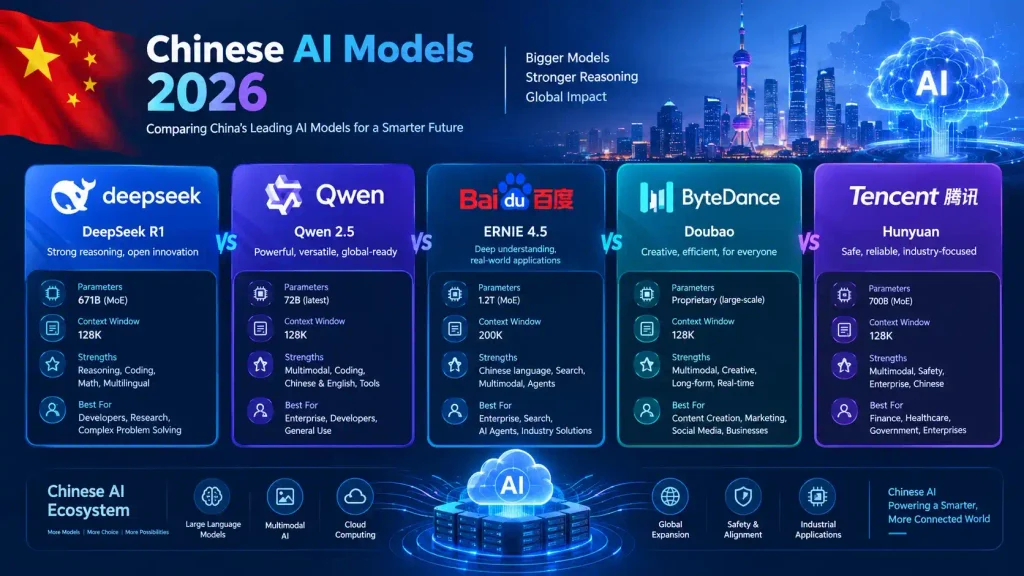
1. DeepSeek AI Models
DeepSeek has become one of the most discussed Chinese AI companies because of its focus on efficient large language models.
Its models are designed for tasks such as:
- General conversation
- Programming assistance
- Mathematical reasoning
- Research support
DeepSeek’s approach has attracted attention because it focuses on model performance and efficiency.
Potential use cases:
- AI assistants
- Coding tools
- Research applications
- Enterprise automation
2. Alibaba Qwen Models
Alibaba’s Qwen (Tongyi Qianwen) family represents one of China’s major large language model ecosystems.
Qwen models are designed for:
- Text generation
- Coding
- Multilingual tasks
- Business applications
- Multimodal understanding
Alibaba has integrated AI capabilities into cloud services and enterprise products.
Potential use cases:
- E-commerce automation
- Customer support
- Business analytics
- Software development
3. Baidu ERNIE Models
Baidu’s ERNIE model family focuses on natural language understanding and generative AI capabilities.
The models are connected with Baidu’s broader technology ecosystem, including:
- Search
- Cloud services
- Knowledge applications
- Enterprise solutions
Potential use cases:
- Search enhancement
- Content generation
- Business assistants
- Knowledge management
4. Tencent AI Systems
Tencent has invested in AI research and applications across its ecosystem.
Its AI development connects with areas such as:
- Communication platforms
- Gaming
- Cloud computing
- Business services
Tencent’s AI systems aim to support consumer and enterprise applications.
5. Zhipu AI Models
Zhipu AI develops large language models based on the GLM (General Language Model) approach.
Its models focus on:
- Natural language processing
- Enterprise AI
- Developer applications
- AI assistants
Zhipu is part of China’s growing AI startup ecosystem.
Key Features of New Chinese AI Systems
1. Multimodal Capabilities
Modern AI models increasingly support multiple data formats.
A multimodal AI system can understand combinations of:
- Text
- Images
- Audio
- Video
This enables more advanced applications such as:
- Document analysis
- Visual search
- AI assistants
- Creative tools
2. Improved Reasoning Ability
AI developers are focusing on models that can handle more complex problems.
Improved reasoning helps with:
- Mathematics
- Programming
- Research tasks
- Business analysis
3. Coding Assistance
AI coding has become a major area of competition.
Chinese AI models are being developed to help with:
- Code generation
- Debugging
- Software documentation
- Programming education
4. Smaller and More Efficient Models
Not every application requires extremely large AI systems.
Many developers are focusing on efficient models that can:
- Run with lower computing requirements
- Support private deployment
- Reduce operating costs
Chinese AI Models vs Global AI Models
| Category | Chinese AI Models | Global AI Models |
| Main developers | Chinese technology companies and startups | Companies worldwide |
| Common focus | Efficiency, enterprise use, local applications | General intelligence, global platforms |
| Applications | Business, government, consumer technology | Business, research, consumer tools |
| Model availability | Some open models and APIs | Mix of closed and open systems |
| Competition areas | Coding, reasoning, multimodal AI | Coding, reasoning, multimodal AI |
Performance differences can vary by model version, benchmark, language, and application.
A model that performs well in one area may not always be the best choice for another task.
Industries Using Chinese AI Models
Healthcare
AI systems can support:
- Medical document analysis
- Research assistance
- Administrative automation
Finance
Financial organizations may use AI for:
- Customer support
- Risk analysis
- Document processing
Education
AI tools can assist with:
- Personalized learning
- Language practice
- Educational content creation
Software Development
Developers use AI models for:
- Programming assistance
- Testing support
- Documentation
Manufacturing
AI can help with:
- Automation
- Quality control
- Industrial optimization
Challenges Facing Chinese AI Development
Despite rapid progress, Chinese AI companies face several challenges.
Computing Resources
Advanced AI development requires significant computing infrastructure.
Access to advanced hardware and efficient systems remains an important factor.
Data Quality
AI models depend on large amounts of high-quality training data.
Data management, privacy, and availability affect model development.
Global Competition
Chinese AI companies compete with leading AI organizations worldwide.
The market continues to evolve quickly as new models are released.
Regulation and Compliance
AI systems must operate within legal and regulatory requirements.
Companies need to consider:
- Data protection
- Security
- Responsible AI practices
Future of Chinese AI Innovation
The future of Chinese AI models will likely focus on:
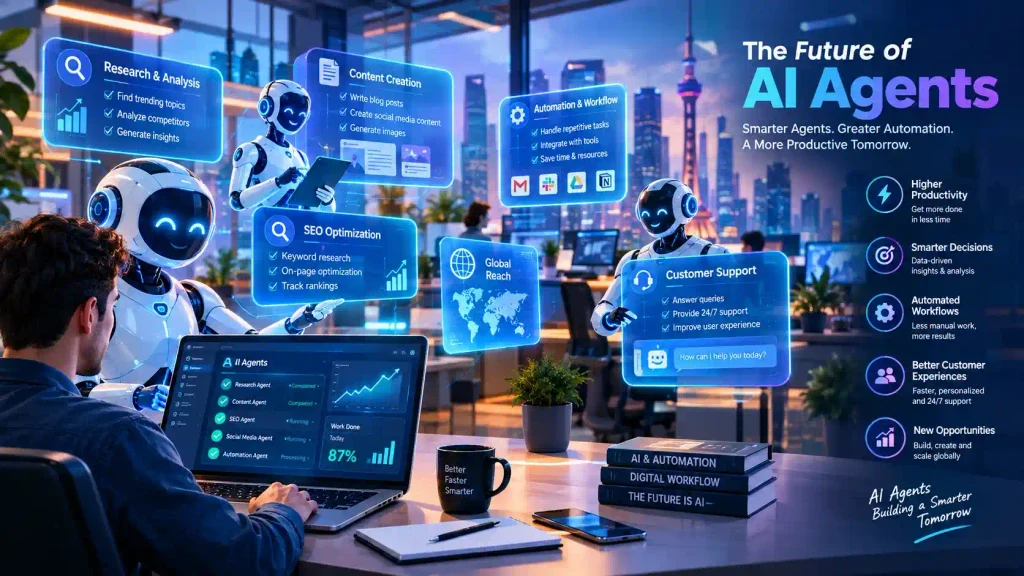
AI Agents
AI agents can perform multi-step tasks with less human involvement.
Possible applications include:
- Business workflows
- Research assistance
- Personal productivity
Industry-Specific AI
Companies are expected to develop specialized models for:
- Healthcare
- Finance
- Manufacturing
- Education
AI Hardware Integration
AI development may increasingly connect with:
- Robotics
- Smart devices
- Industrial systems
Global AI Competition
Chinese AI models will remain part of the broader competition to develop more capable, efficient, and useful AI systems.
Frequently Asked Questions
1. What are the biggest Chinese AI new models in 2026?
Major Chinese AI model families include DeepSeek, Qwen from Alibaba, ERNIE from Baidu, GLM models from Zhipu AI, and other systems developed by Chinese technology companies.
2. Are Chinese AI models as powerful as global AI models?
Performance depends on the specific model, version, benchmark, and task. Different AI systems may perform better in different areas such as coding, reasoning, languages, or business applications.
3. Are Chinese AI models open source?
Some Chinese AI models provide open access, model weights, or developer resources, while others are available through APIs or commercial platforms.
4. What industries use Chinese AI models?
Chinese AI models are used or explored in industries including software development, finance, healthcare, education, manufacturing, and customer service.
5. Which Chinese AI model is best for coding?
Several Chinese AI models focus on coding capabilities, but the best choice depends on programming language, project requirements, performance needs, and deployment options.
6. Will Chinese AI models compete globally in the future?
Chinese AI companies are actively developing advanced systems, and their future impact will depend on innovation, resources, research progress, and global market adoption.
Conclusion
The rise of Chinese AI new models in 2026 shows how quickly the artificial intelligence industry is expanding beyond traditional technology centers.
Companies such as DeepSeek, Alibaba, Baidu, Tencent, and Zhipu AI are contributing to a growing ecosystem of large language models, multimodal systems, and enterprise AI solutions.
While challenges remain around computing resources, regulation, and global competition, Chinese AI development is expected to remain an important part of the future AI landscape.
For businesses, developers, and technology professionals, understanding these models can help identify new opportunities in automation, software development, and AI-powered products.
